

Are we ok?
Epidemic loneliness and divine displacement

May 3, 2025
Hey friends, writing to you from Manitoulin Island 🇨🇦.
It's Saturday and you know what that means? Porketta Bingo at Sudbury’s Beef n Bird, of course.
It's one of the last remaining social clubs in this blue collar mining town.
We’re gambling for meat trays.
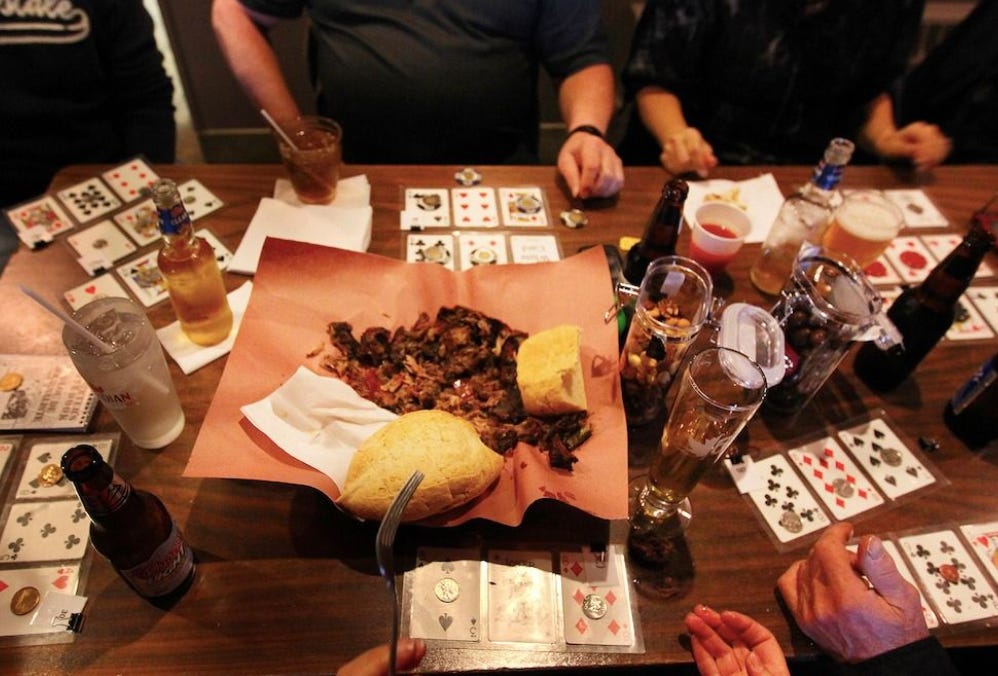
This is where community happens in Sudbury which has a severe lack of curated third spaces and cute cafes. But this wood-paneled room that smells like cigarette smoke and potlucks from 1987 makes a lot of sense for this town.
This is one of the last honest OG gathering places. Nobody's networking here or building their brand. Ron’s been calling the same numbers for fifteen years and everybody knows that if you win the round, you'd better yell out “Porketta!” or be publicly shamed.
It matters that these places exist. Porketta Bingo and its guises are the real glue of civilization.
Anyway, today's essay is about belonging, displacement, and why I'm about to trade Porketta Bingo for pirate democracy.
There's a difference, but not as much as you'd think.
- Jessica
Are We Ok?
"What could be more normal than to be out of place everywhere you go?"
I read that in Andrew Sean Greer's novel "Less Is Lost" while in Sardinia last month feeling a little out of place… as usual.
I've been thinking about this question of belonging with increasing urgency lately. In just a few months, my partner and I will move onto a sailboat, embarking on a multi-year journey that will make us permanent visitors everywhere.
We'll be circumnavigating the globe, floating between continents and cultures with no fixed address to return to.
What a thing to say. "I'll be circumnavigating the globe." Feels cool.
I'd imagine much of that experience will be extraordinary and epic, but one of my biggest worries is around making friends and community.
This is something we want to do, must do, otherwise we'll become feral sun damaged sea hermits who communicate through interpretive seagull noises.
Basically, I'm afraid of being lonely.
Having a sense of belonging matters deeply to me… as it does to most people. So why choose a lifestyle that seems fundamentally at odds with this basic need?
What kind of person deliberately chooses to be permanently out of place?
Am I going to be ok?
Are we ok?
Honest question.
Because the data suggests we're not really:
78% of Gen Z and Millennials report feeling lonely despite being the most digitally connected generations in history.
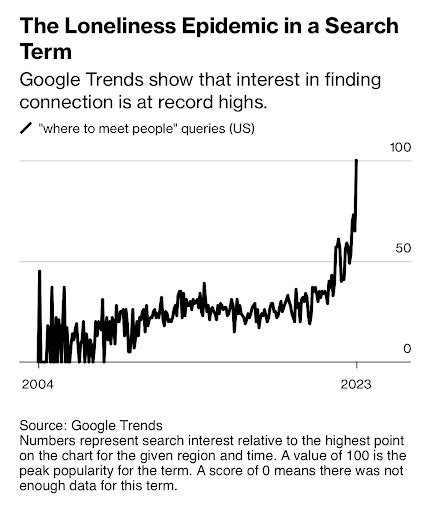
It's clear a sense of displacement is a big problem.
And I think it deserves some attention because the epidemic of loneliness we're facing is much different from the natural feeling of not quite belonging.
Both are important to know about.
The epidemic kind is the artificial isolation we're experiencing in our hyperconnected world. The kind that has us surrounded by people yet deeply alone, performing connection rather than experiencing it.
This is the loneliness that needs solving for, like yesterday.
And then there's the divine kind… the natural displacement that comes from being alive, awake, and aware of our temporary status in this vast cosmos. The kind that fills us with wonder rather than emptiness.
When I was in NYC last week visiting a good friend (who just so happens is building something to solve for the epidemic kind) I also got to experience that divine version in a big way.
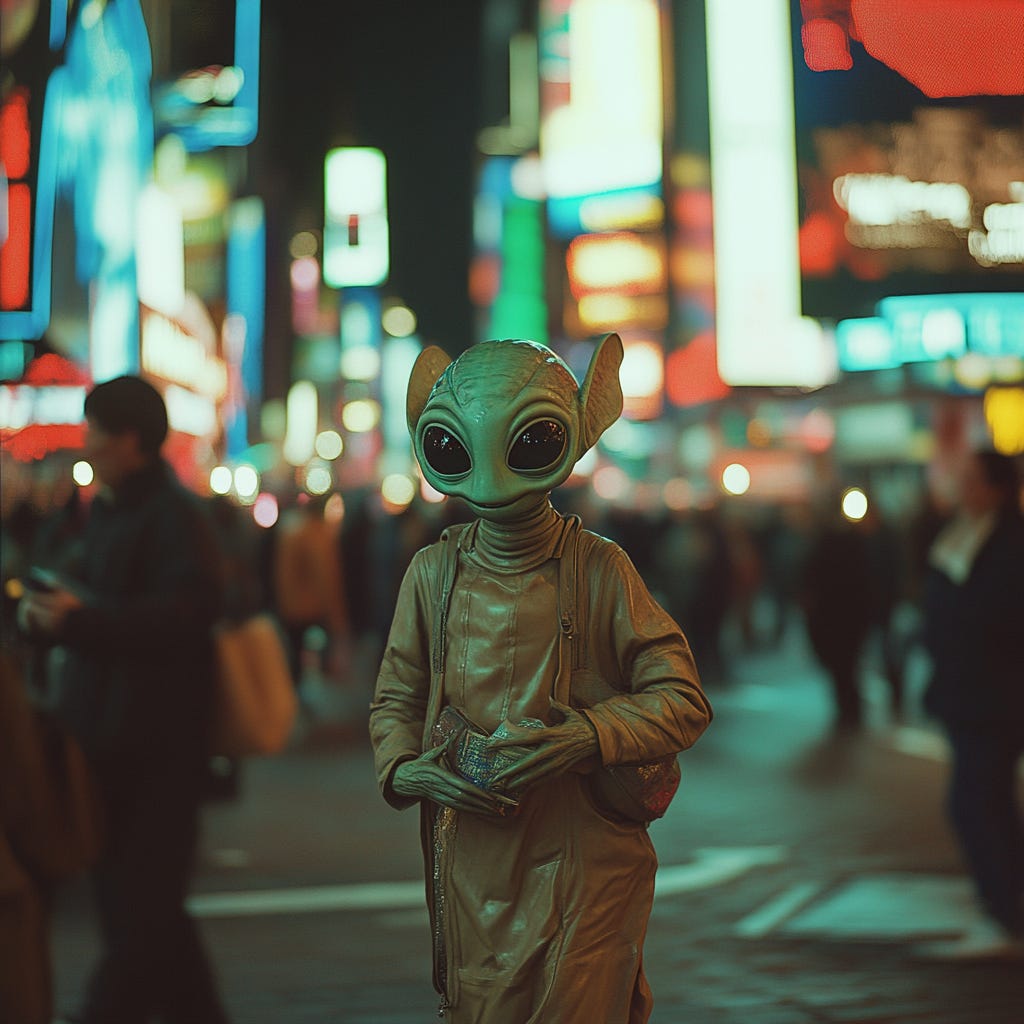
I've been in many different countries over the last few months but to feel so alien in my own is a fun thing to experience.
Nothing has made me feel more like a foreign being than trying to navigate the New York subway system.
Thankfully Katherine was there to guide me through the impossible maze. A few times she stepped back and I briefly took the lead.
I hope she enjoyed watching me stand before the subway turnstile, an ancient deity requiring precise ritual offerings, making an exhaustible task out of operating the tap function.
But being utterly out of place has some major pros.
The visitor sees.
When you're new somewhere, you actually see it.
While there are a ton of benefits to being a local, one of the downsides is we essentially become very sophisticated sleepwalkers. When you live somewhere, you move through its streets with unconscious efficiency.
But you really see a place when you're new, when your perceptions haven't calcified into assumptions.
The visitor tastes that New Yorker slice with attention rather than habit.
The visitor is awake.
When you don't know the rules, you just have to be.
When you can't assume understanding, you have to ask questions and risk looking like the person who needs step-by-step instructions for operating a turnstile.
I think the feeling of displacement is an essential condition of consciousness.
As far as I know, we all experience feeling like we don't belong sometimes. And we can't all be outsiders.
We've confused belonging for the confidence of the insider, security of permanence, and the comfort of knowing rather than discovering.
And I'm starting to believe that belonging is about something different altogether.
The visitor is present.
Think of the Portuguese concept of saudade: a longing for something absent, a presence in absence.
As visitors, we carry this feeling constantly.
We're always partly elsewhere, aware of what and who we've left behind.
This bittersweet awareness creates tenderness and importance toward the present moment and those who share it with us knowing this is precious and temporary.
The visitor is an endearing hairless ape who needs a little support.
The local knows the shortcuts, speaks the language, understands the unspoken rules. The visitor stumbles, misunderstands, occasionally accidentally offends.
There are few feelings more vulnerable than being somewhere you don't belong. But this vulnerability can create openings that confidence never could.
People respond to sincere curiosity with generosity. They laugh with you at well-intentioned mistakes. They share insider knowledge with surprising readiness when approached without presumption.
Genuinely needing help is a very quick way to dissolve barriers between people.
The good people you meet as a visitor don't seem to care much about status but do care about your sincerity. Your willingness to listen, to learn, to acknowledge what you don't know. Your ability to say "I am completely lost" with the same cheerful tone you might use to announce you just found $20 in your pants.
Integration with humanity happens through vulnerability, not mastery.
We bond through the shared experience of being hilariously inadequate in the face of existence.
Sailors: A community of visitors

I want to highlight the sailing community here because they generally operate on this beautiful principle: today's stranger is tomorrow's lifeline, and we're all just helping each other stay afloat.
Sailors live on treacherous terrain that doesn't care about resumes, social status, or followers. The ocean is the great equalizer, and it teaches you quickly that your survival might depend on the kindness of that boat you've never seen before.
On the water, you never feel more clearly that you don't belong anywhere specifically because you belong everywhere generally, a visitor in good standing to this remarkable planet.
The ocean demands exactly what healthy human connection requires: honest vulnerability, attentive presence, and the humility to know we control almost nothing.
Out there, you learn quickly that survival often depends on strangers becoming allies. You radio for help when your engine dies. You offer a spare part to the boat anchored nearby. You share weather updates, anchorage tips, and often dine with people whose names you learned five minutes ago.
Pirates understood this too.
Despite their reputation for lawlessness, they had their own code of radical democracy and mutual aid. When you're living on borrowed time in an environment that wants to kill you, you develop a different relationship with community.
Pirates elected their captains, shared plunder equally, and had surprisingly progressive disability benefits (losing an eye was worth 100 pieces of eight, if you're curious).
Maybe that's what we've lost in our land based communities… the visceral understanding that we need each other.
We've become so comfortable in our illusion of self-sufficiency that we've forgotten how to be properly vulnerable with strangers.
At the risk of sounding like I work for Big Ocean and spreading my anti-land propaganda… Cities let us maintain the idea that we're self-sufficient. Order dinner from an app, work from home, call 911 in the case of an emergency. We've built systems so good at meeting our needs that we rarely have to ask Jeff from 8S for help with anything.
Not that sailors are some enlightened species. It’s that the ocean is a more honest teacher.
Consider an environment that makes our interdependence so obvious we can't ignore it.
No pretense, no performance.
Just "Hey, I'm in trouble" and "Yeah, me too sometimes, here's what worked for me."
So, on second thought, I'll be ok.
And we'll all be ok.
What does it mean to really belong?
Notice the tension in the word "belonging."
Be-longing.
To be is one thing. But to be longing? That's the human condition in two words.
Maybe we find our people and our place but we still yearn for something deeper? This is common.
So maybe true belonging isn't about arriving somewhere perfect but about recognizing that we're all searching for the same cosmic connection.
It's recognizing the eyes of a kindred spirit and silently communicating, "You too? Excellent. Let's be confused together."
The longing itself might be what binds us most deeply.
Nobody belongs here more than anybody else.
Nobody belongs anywhere, really.
So maybe the answer to "where do I belong" is everywhere and nowhere.
And instead of asking ourselves where we fit in, we strive more towards practicing a more honest way of being human with humans.
To align our physical reality with this philosophical truth: we are all perpetual visitors, passing through.